How To Get Lost In Marseille
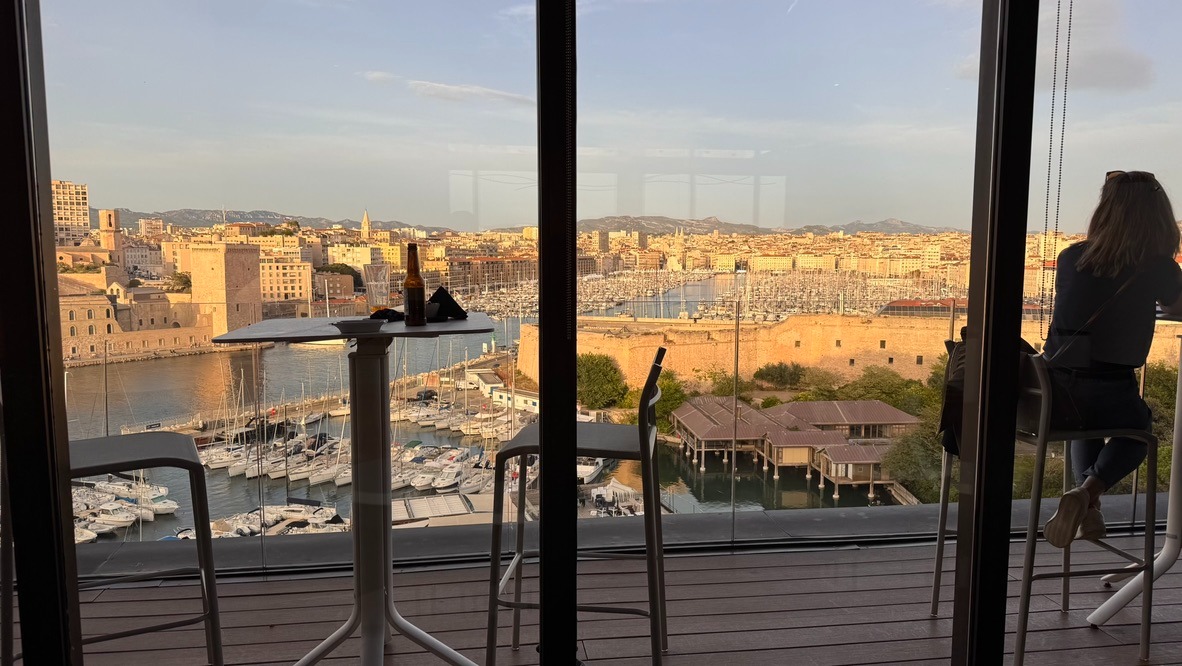
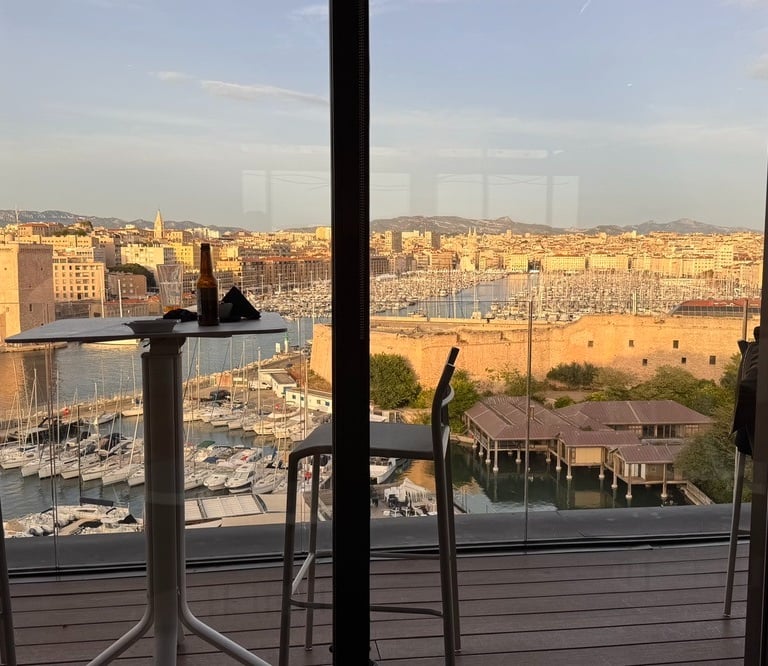
This short story was inspired by the view of the hotel in Marseille overlooking the historic harbor and three forts.
by Paul and Cicek Bricault
2/1/202611 min read
The hotel room smells faintly of mildew and not at all like the beginning of a good story. Julian pauses just inside the door with his suitcase handle still in his fist, as if the room might offer him a better opening line if he waits long enough. He crosses to the desk, brushes his fingers over the wood, then the bedside table, then the chair back. The furniture is clean. The lines are straight. The lamp works. Everything is in order. Yet nothing calls to him.
Behind him, Amelia stands at the window without taking off her coat. She has a steady posture—shoulders square, feet planted—like someone used to assessing a place quickly and making it work. Silver threads run through her dark hair, swept into a low clip that reveals the clean line of her jaw.
Outside, the harbor glitters and the city folds around it, layered with balconies and bright shutters and a wind that looks sharp enough to cut. Three forts sit across the water, heavy and resolute – silent guardians of history. Amelia traces their outlines on the glass with one fingertip. She watches the forts as if the view is something to solve rather than something to feel.
Julian sets his laptop bag down carefully—always carefully—and exhales through his nose.
“This isn’t it,” Amelia says. Her tone suggests she is already composing a polite request, already planning the route to the front desk.
“Let’s give it a minute,” Julian replies, though what he means is: Let me figure out how to make this better. He needs the room to deliver something he can turn into a sentence.
Amelia turns from the glass and looks around once, fast. The bathroom door is half ajar. The towels are too thin. The air feels as stale as the doctor’s office she was in a week ago back in Chicago, when her mind went numb as the oncologist explained her test results. She still hasn’t told Julian. Her hope is she’ll never have to.
“Let’s ask for another room,” she says. “Somewhere with air.”
Julian finally nods, grateful for a decision he doesn’t have to make.
At reception, Amelia delivers the request in passable French. There is a pause, then apologies, then a new keycard. When the elevator doors open again, the hallway smells of citrus polish instead of damp carpet. The upgraded room has a balcony and a view that hits Julian’s chest like a quiet shove. Again, the harbor opens below them, wind-rippled and bright. Across the water, Fort Saint-Jean and Fort Saint-Nicolas glow in the afternoon sun. Farther up, on the hill, Notre-Dame-de-la-Garde watches the city with her gold crown and a stillness that feels almost human.
Amelia steps outside before the door even clicks shut, both hands on the railing as if to anchor herself against the sweep of sky. She forces her body into the moment, even when her mind wants to jump ahead.
Julian follows more slowly. He checks the angle of the view, the way the light falls on the stone, the possible headings forming in his head. It’s a habit he doesn’t notice until it fails to satisfy.
“I need this article,” he says, “Ten Essential Ways to Experience Marseille.”
Amelia doesn’t turn around. She squints toward the forts as if something is moving there. “Maybe we only need one,” she says, trying to smile. “But we’ll see.”
Julian pulls out his notebook. The paper is crisp. The pen clicks. He writes down what she said, though he doesn’t yet know what it means.
The next morning, the port smells like diesel and salt and something fried. Julian tells himself the smell is “authentic” and writes it down. Amelia buys two harbour tour tickets without asking what time they return.
The boat rests at the edge of the dock, steadfast and patient. Captain Lucien waits at the gangway, wiry and weathered, his face marked by a city he knows too well to explain anymore. A neatly tied white scarf adorns his throat—once a symbol, now habitual, like much of his day. His gaze passes over each passenger without lingering, cataloging them the way one might count tides or clouds: familiar, temporary, already on their way elsewhere.
Aiko and Ren board just ahead of them—a Japanese couple in their late twenties. Aiko wears a cream trench coat that makes her look like she belongs in a magazine spread, and her camera hangs from her neck like an extra appendage. Ren is compact and quiet, hair cropped short, hands hovering near Aiko’s elbow as if ready to catch her from some indeterminate threat. He guides her to the bow of the boat, where he offers her a seat, but Aiko is too busy taking photos to settle in.
After Julian and Amelia, Camille steps aboard, braid tight, canvas bag heavy at her hip. She has the kind of posture that suggests she can lift something dangerous without flinching– which has become de rigueur after working the past four years at the French nuclear plant. She came here on her day off – what better than a boat ride to relax. But training sends her gaze to the engine housing, then to the ropes, then to the emergency equipment.
Theo comes last, lanky and rumpled, a student from the University of Norway; he holds a thick paperback history book with a cracked spine. His glasses sit slightly crooked on his nose, and he keeps pushing them up as though knowledge itself might slide away if he stops.
“Welcome to the 10 a.m. Marseilles harbour tour,” announces Lucien with the jaded tone of someone reciting lines in a play they have long grown tired of performing. The captain continues with the standard safety talk, his voice flattening as if his words are a costume he wears. Julian listens with half his mind and takes notes with the other half.
The boat pulls away. Marseille opens and folds around them—stone and glass, gulls and cranes, a city built by hands that once smelled like fish and rope. Aiko takes a photo, rotating her arm to capture the entire city in one frame. Julian pictures himself writing the note later: Number Three: Take the Boat Tour for a Panoramic View.
“Incredible,” exclaims Aiko, “this vista is so reminiscent of Naples.”
With a scowl, Lucien shakes his head and mutters, “damn tourists,” under his breath. He then cuts the engine slightly while turning the wheel sharply to port, veering away from the expected route.
Julian looks up, startled. “This is not on the brochure.
Lucien glances back, lips twitching like he’s almost amused. “You want to actually know Marseille, yes?” he asks. “Then you go where the city hides itself.”
Julian’s notebook hovers midair.
Amelia bumps his shoulder lightly—an intimacy disguised as accident. “Let’s just follow him,” she says. “Maybe this is the part people don’t write about.”
Lucien steers them toward Fort Saint-Nicolas, docking in a narrow slip that looks distinctly unofficial. The stone steps up from the water are slick with algae. The fort wall looms like a held breath. Lucien disembarks and gestures for them to follow.
Once inside the underbelly of the fort, the air cools and thickens. The tunnel smells of wet stone and old salt. Their footsteps echo, as if the place is listening.
“This isn’t part of the normal Saint-Nicholas tour,” Aiko says quietly.
Lucien smiles without turning. “That’s the point.”
The tunnel slopes downward until the light behind them thins to a pale ribbon. At the end of the passage, the air shivers - a faintly flickering oval seam cuts into the dark, barely holding its shape.
Ren stops short. “Do you see that?”
Theo grips his book. “What is that? Are we seeing things?”
Lucien steps forward. “Watch and you will see,” he says with a smirk. And then he seems to vanish.
Aiko gasps.
Camille swears under her breath.
Theo takes a step back.
Amelia reaches out. The air bites lightly, like static. She doesn’t pull back. She looks at Julian. Not asking. Not pleading. Simply offering.
“Amelia,” Julian says. “Maybe—”
“If we wait,” she says, “we’ll talk ourselves out of it.”
She steps through.
Julian feels the familiar urge to narrate, to capture the moment so it won’t undo him. He takes a deep breath and follows.
Aiko, gripping her camera tightly, walks through next with Ren right on her heels.
Camille presses her palm against the wall, brow furrowed, as if looking for a logical explanation in the stone itself. “Well, better see what’s on the other end?” she says with a shrug to Theo, who takes a step back. Camille turns and is gone.
Theo stands alone in the tunnel, the shimmer hums softly, indifferent. He shouts into the void – “this isn’t safe – you don’t know where this leads!”
Smoke hits first. Then noise. Then heat.
The street is narrower. The buildings press close. The air is thick with bodies. Drums beat not for celebration but for impact, for keeping fear from turning into chaos.
“What is this?” Ren asks.
“Marseille,” Lucien says. “Just not yours.”
People surge uphill, toward the fort, toward the hill where Notre-Dame-de-la-Garde watches. Men carry muskets. Women hold baskets—many empty, some with scraps of hard bread. Children cling to skirts, eyes alert.
Julian tries to anchor himself with facts—year, revolution, context—but nothing settles. The language is French, but rougher, faster, spiked with anger.
A man shouts about grain. Another about taxes. Someone screams that the royalists are hoarding food while their children starve.
Amelia’s hand finds Julian’s and grips hard. Julian tightens his fingers around hers and stays where he is instead of stepping back to “observe.”
A woman stumbles near them, her basket slipping. A child tumbles after it. Ren reaches out without thinking, catching the woman’s elbow before she falls. The woman nods once—sharp, grateful—and is swallowed by the crowd.
Aiko lifts her camera, then stops. The lens cap clicks back into place.
Meanwhile, Camille scans the area — exits, bottlenecks, sources of danger. She watches the way bodies compress and how easily a single spark could turn this into a stampede.
Then Lucien appears—except it is not the captain from the boat, not exactly. He looks younger, or perhaps the light is different. He is pulled from behind by rough hands.
“Espion!” someone shouts.
“Marin!” another voice snaps back.
The words blur. Lucien is shoved to his knees. His hands are forced behind his back. A musket barrel presses near his neck. Lucien’s face hardens. “Release me, this instant,” he demands.
"Shut up, you fool. You selfish monarchist.” The man brandishes Lucien’s white scarf. “We will no longer be under your rule. Today we fight for our freedom.” He spits in Lucien’s face.
“But you’ve made a mistake.” Lucien now begs.
Julian’s heart bangs against his ribs. He feels the old reflex surge—stand apart, watch, remember, write later. But there is no distance here. The crowd is a living thing. The dense air is shared, and the consequences are immediate.
“Spy!” someone shouts again—louder, desperate, needing certainty.
Rifles rise. For a split second, Julian believes he is about to watch a death he will never be able to unsee. Amelia breaks free of the crowd and steps between Lucien and the nearest musket. Her body moves deliberately, without thinking of her own safety. The man holding the musket is barely older than Ren. His dirt-stained shirt hangs loose. His face is tight with hunger, duty, and fear. His eyes flicker past Amelia to the crowd: women with empty baskets, children with hollow cheeks, men with cracked hands.
Julian’s notebook sits like a weight in his pocket. He thinks of his list, absurd now, obscene. But it’s all he knows…to write. But writing will not stop a trigger. Julian steps forward, voice shaking, French uneven but real. He repeats what he has heard since arriving—grain locked away, taxes crushing, sons taken. He doesn’t argue philosophy. He names the situation that the people already know in their bones.
The crowd shifts. Someone near the back shouts, “Bread!” like it’s a verdict. Another voice answers: “Not him—open the stores!” A woman yells that killing one man won’t feed her child.
Camille moves in, calm and sharp. She points to the narrow street. “One shot could turn the whole crowd into a panic that crushes our own people,” she warns. She speaks like a true engineer reading a system: consequences, chain reactions, shared vulnerability. Then she does something subtle, nearly invisible: she stops holding her insight like a weapon and offers it as a tool.
The soldier tightens, then loosens. His shoulders sag as if he has been waiting for permission to choose differently. He lowers his rifle. Another soldier hesitates, then follows. A murmur ripples outward—less rage now, more direction. Drums begin again, keeping the crowd moving as a single organism. A knife appears—someone cutting rope, hands quick. Lucien’s wrists are freed. Lucien sways, then steadies, breathing hard. For a moment, he looks ready to bolt. But Amelia’s hand touches his arm—brief, grounding—and he stays, placing his hands on his heart in a brief gesture of gratitude. They move with the current, pulled through side streets, away from the densest pressure.
Amelia keeps a palm on Julian’s back as if to remind him he is still in his body. Ren stays close to Aiko, but without gripping. Camille watches corners and steps to the beat of the now distant drums. The group finds the fort’s shadow again, the air cooler, the stone familiar. The portal shimmers where it did before, waiting like a held breath. Lucien gestures them through. They step together, and the world flips back.
The tunnel is quiet. The air smells like wet stone again. Theo stands exactly where they left him, his book slack in his hands. His face is pale. His eyes search them as if he expects the story to be clean, like a chapter summary.
“What happened? Where did you go?” Theo asks wide-eyed.
But they are ash-streaked. No one speaks. Their breathing uneven. Lucien’s wrists are raw where the rope bit him, his scarf rumpled and torn. Amelia’s hands tremble when she glances at it. Julian’s notebook is still in his pocket, but he hasn’t touched it.
Theo’s tries again. “Did it—” he begins, then stops. He looks at Lucien’s wrists. At Amelia’s expression. At Julian’s face, which is quieter than usual. “Everything in here is someone else’s courage. Not mine.” Theo says in a thin voice. He looks down at his history book—pages full of dates and outcomes, none of them carrying the smell of smoke or the weight of a person’s life in one’s hands. He lets the book fall. It hits the stone with a dull thud. Theo then steps towards the shimmer. His breath quickens. He hesitates only once, looking over his shoulder at the others. He then steps into the portal and is gone.
Julian stares at the empty shimmer as if watching someone walk into a storm. Amelia squeezes his hand once, steady.
Outside, Marseille continues—boats, gulls, tourists laughing on the sunlit dock. The present feels both safe and strange, like a room you’ve lived in for years but see only now for the first time.
Back at the hotel, the balcony door is open. The wind carries harbor sounds up to them—voices, engines, a distant accordion. Julian sits at the desk with his laptop open. For once, he doesn’t start with a list. He stares at the blinking cursor. His hand hovers over the keys. He thinks of the eyes of the young revolutionist who held the musket. The empty baskets. Amelia stepping forward. He types one sentence. Then stops.
On the bed, Amelia lies on her back with her eyes closed, breathing evenly. Her face looks softer—not happy, exactly, but unbraced, as if her body has stopped preparing for impact.
Later, they return to the harbor and watch Lucien from the dock. He is back on his boat, the tattered scarf still at his throat, hands steady on the rail. He calls out to new passengers with the easy confidence of someone who is well-versed in the intimate secrets of Marseille.
On a bench above the docks, Aiko raises her camera, but this time she pauses, looking at Ren first—asking, silently, Do we want to capture this or live it? Ren smiles and shrugs, and she takes a photo anyway, but slower, gentler, as if the image is not a shield but a souvenir.
Camille is once again aboard Lucien’s boat. She stands near the engine housing and listens to it hum. She doesn’t look afraid of the power under her feet. She looks thoughtful, as if imagining what it means to build something that people trust—something that serves rather than dominates.
The boat pulls away.
Lucien glances back once, toward the fort, toward the city. His expression is unreadable, but his posture is lighter than it was before, as if he no longer believes he has to steer every outcome alone.
Julian and Amelia stand shoulder to shoulder at the edge of the dock. The forts sit across the water, silent and enduring. Somewhere inside one of them, Theo is living what he once only read.
Julian doesn’t say, This will make a great story. He only says, quietly, as if to himself, “We got lost.”
And Amelia smiles.